








Customer line 9 am - 6 pm: +420 774 590 258 | Do you need help?
| Price in e-shop with VAT: | 18,81 € |
|
Stock
Monday 23.11. you can have it at the Nademlejnská central store Tuesday 24.11. it can be at your place |
|
|
|
Buy |
| Buy | |
|
We have been on the business for 35 years = safe shopping and professional services |
|
Don't know how to choose? Are some parameters not clear to you? Write us your question and we will contact you with an answer.
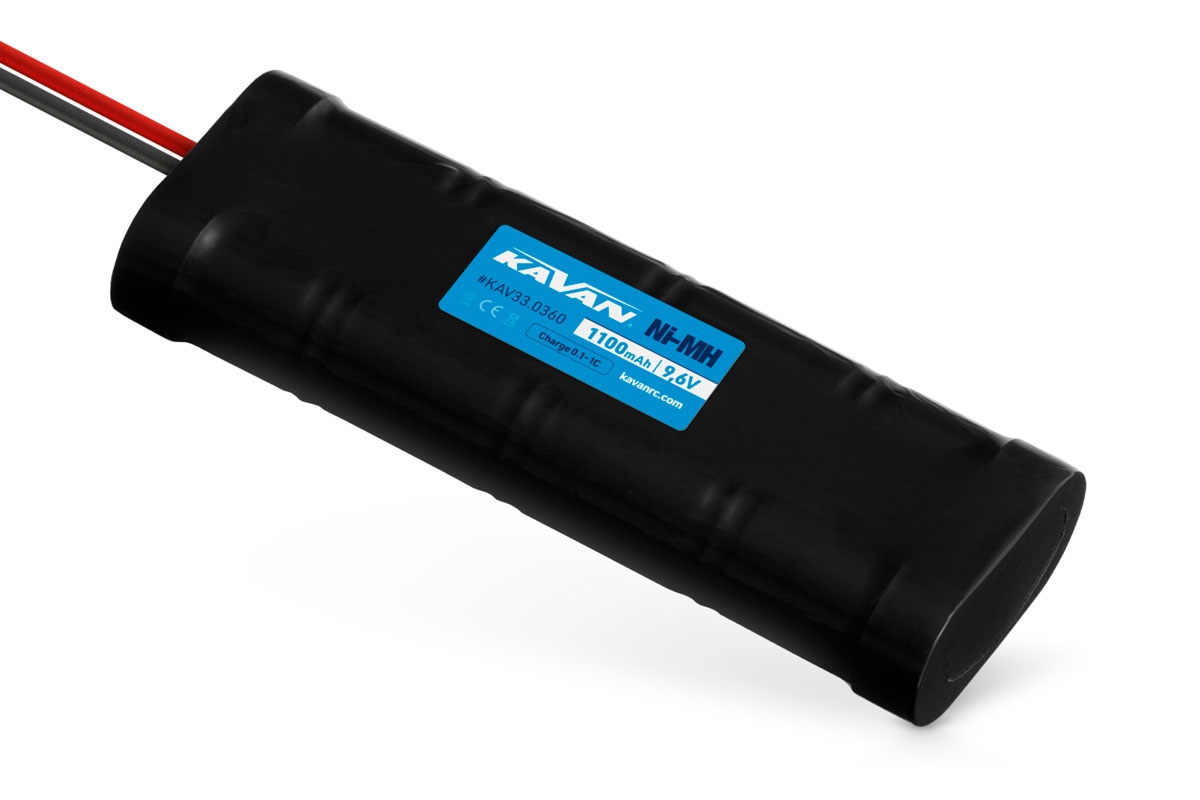
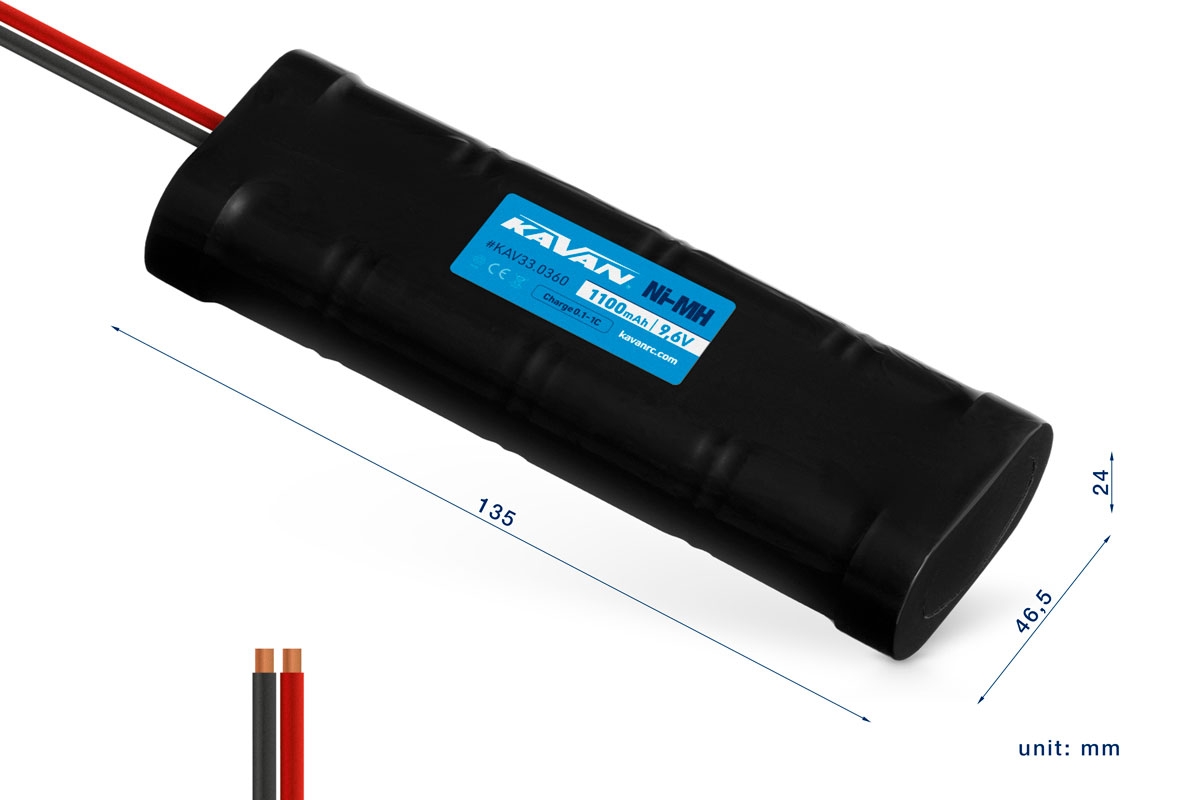
Send a questionEight-cell Kavan NiMH 9.6 V drive battery pack with a capacity of 1100 mAh and a 10C discharge rate, in a stick configuration. The battery is supplied without a power connector. Dimensions: 135×46.5×24 mm, weight: 260 g.
Kavan Standard series NiMH packs are assembled from nickel-metal hydride cells that support fast charging and discharging. Receiver packs are fitted with a lead/charging cable with a standard JR/UNI connector; drive packs are supplied without connectors. They are designed to power or supply the onboard electronics of smaller RC models of all types.
Installing the battery
Protect the battery from vibration, impacts and shocks that may occur during operation of RC models (wrap it in foam rubber or similar material). Secure it, for example, with hook-and-loop tape or cable ties, so that it cannot come loose in flight. Position the battery in an easily accessible place in the model, where it will be protected from fuel, exhaust gases, operating fluids or water getting in.
Using the battery
The batteries are intended to power small RC models or supply onboard electronics in smaller RC models that do not require a higher current load. A typical application is a setup with a receiver and 3–4 standard-size servos (approx. 3–4 kg/cm of torque) or smaller servos with 1050 mAh battery packs, or 2–4 micro servos or pico servos with 350 and 650 mAh battery packs. If your onboard electronics include more servos or larger servos, use batteries with a higher current rating. Otherwise, the batteries may not be able to handle current peaks, and the resulting voltage drop under excessive load could cause the receiver to stop operating, risking a model crash.
Charging the battery
Fully charge the battery before first use. We recommend slow “overnight” charging of receiver batteries at a current of 0.1C, i.e. 100 mA for a 1050 mAh battery. In this case, the batteries can be charged safely without removing them from the model. If you insist on faster charging for any reason, always remove the batteries from the model before charging. Given the current rating of the connector, cable and batteries, we do not recommend using a charging current greater than 0.5C. Do not charge drive batteries at a current greater than 1C. The battery temperature during charging should not exceed 40 °C (the battery should feel warm to the touch, not hot).
Conditioning the batteries
To prepare a new battery for optimum operation, we recommend an initial conditioning process consisting of 3–5 cycles of slow charging at 0.1–0.2C and discharging at a maximum of 1C. The amount of charge put in is not particularly important; the amount of charge discharged is what matters. Stop conditioning once the amount of charge discharged no longer changes significantly (individual readings should be within approx. 5–10% of each other). We recommend the same procedure after the batteries have been stored unused for a long period (several months).
Discharging the batteries
If you use slow “overnight” charging at 0.1–0.2C, there is no need to discharge the batteries before every charge. However, we recommend fully discharging the batteries every 3 months (to 1.0 V per cell, i.e. 4.0 V for a four-cell pack) and then fully recharging them to keep them in optimum condition.
If you use faster charging, we recommend fully discharging the batteries before charging (to 1.0 V per cell, i.e. 4.0 V for a four-cell pack). If the batteries become warm during discharge, let them cool to ambient temperature before charging. In use, the batteries should not heat up above approx. 60 °C (the battery will feel hot to the touch, but can still be held in your hand). If this happens, you should either change the battery's operating conditions (reduce current draw) or use batteries with a higher current rating.
Storing the batteries
NiMH batteries should be stored fully charged. If you know that you will not use the batteries for more than 3–4 weeks, charge them fully and store them in a dry place at normal room temperature. For long-term storage, we recommend fully discharging the batteries every 3 months (to 1.0 V per cell) and then fully recharging them. Please remember that a battery's ability to retain its charge depends significantly on the temperature at which it is stored. While a properly maintained battery stored at room temperature will still retain approx. 60–70% of its charge after 1 month, at 40 °C it may retain only 20–30%.
| Capacity [mAh] | 1100 |
| Voltage [V] | 9.6 |
| Charging current [mA] | 110 |
| Max. charging current [A] | 1.1 |
| Max. discharge current [A] | 11 |
| Low self-discharge | No |
| Length [mm] | 135 |
| Width [mm] | 46.5 |
| Height [mm] | 24 |
| Weight incl. cable and connector [g] | 260 |
1 item
This website is using cookies
In order to improve our services, we use cookies on this website. For more information go to Terms and conditions for use of website.