








Customer line 9 am - 6 pm: +420 774 590 258 | Do you need help?


| Price in e-shop with VAT: | 388,93 € |
|
Stock
Tuesday 24.11. you can have it at the Nademlejnská central store Wednesday 25.11. it can be at your place |
|
|
|
Buy |
| Buy | |
|
35 years in business = safe shopping and professional service |
|
Don't know how to choose? Are some parameters not clear to you? Write us your question and we will contact you with an answer.
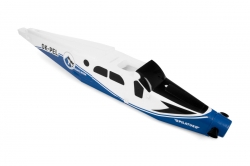
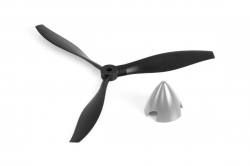
Send a questionAlmost-ready-to-fly semi-scale model of the Swiss STOL utility aircraft, with a 1500 mm wingspan, made from virtually indestructible, carbon-reinforced extruded polyolefin foam (EPO). Equipped with a C3548-750 brushless motor, 10×6" three-blade propeller, R-40SB ESC, 6 micro servos and LED lighting. Ailerons, flaps, rudder, elevator, steerable tailwheel/water rudder and motor speed are controlled.
The Swiss single-engine STOL utility aircraft Pilatus PC-6 Porter, originally powered by a flat-six Lycoming piston engine, first flew in 1959. The improved Turbo-Porter, powered by a turboprop engine, soon followed. Over the years, these magnificent aircraft have taken to the skies with Turbomeca Astazou II, Garret Air Research TPE 331 and finally Pratt & Whittney Canada PT6A engines (about 70% of all units produced).
Their incredible, almost helicopter-like short take-off and landing capabilities soon attracted the attention of military and civilian operators. Porters equipped with wheels, skis or floats have served reliably and tirelessly around the world—and continue to do so—flying over deserts, jungles, lakes, mountains, snow and ice—practically everywhere. It is no wonder that the PC-6 holds the world record for the highest-altitude aircraft landing, on the Dhaulagiri glacier in Nepal.
After 604 aircraft had been completed over 63 years, Pilatus ended PC-6 production in 2022. Now you can enjoy flying a 1500 mm wingspan semi-scale model of this magnificent aircraft, powered by a high-performance brushless motor!
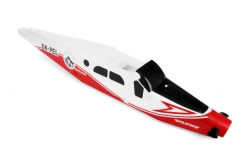
The model’s fuselage is made of highly durable EPO foam (extruded polyolefin) with internal carbon reinforcements. A C3548-750 brushless electric motor with a 10×6“ three-blade propeller and a Kavan R-40SB ESC with a powerful BEC power supply stabilizer are installed in the nose. There is plenty of room for the flight battery under the removable nose cover.
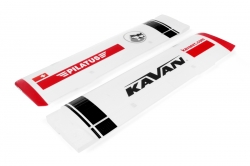
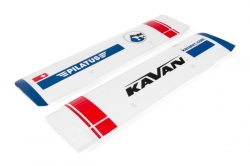
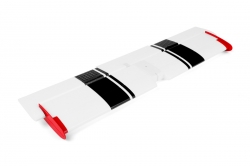
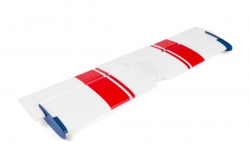
The EPO foam wing is two-piece, with carbon spars and a carbon tube joiner. The ailerons and flaps are controlled independently, each by two servos with short, straight wire pushrods. Functional LED navigation and landing lights are also included. The easily removable carbon wing struts are secured with clips.
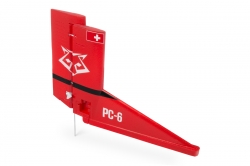
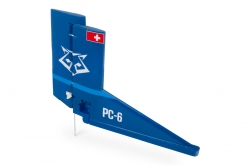
The tail surfaces are also made of EPO foam. The rudder servo is housed in the fin, and the elevator servo in the fuselage. The control surfaces are operated by short wire pushrods.
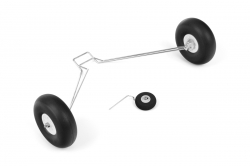
The fixed main landing gear is made of sprung wire and fitted with scale struts. The wire tailwheel is linked to the rudder. A float set is available separately for the model. Removing the wheeled landing gear and installing the floats and water rudder takes just a few minutes.
The model is powered by a C3548-750 class brushless motor paired with a Kavan R-40SB 40 A ESC. You will need a 4-cell LiPo battery with a capacity of 2600–3300 mAh and a discharge rating of at least 30C. Choose a specific battery type that gives you the correct centre of gravity position with as little additional balancing as possible.
For emergency control of the model, even a six-channel computer RC system without special functions will suffice, since in the basic configuration the ailerons, flaps, rudder and nose gear servo are each connected to a single channel via the distribution board installed in the cabin area.
The distribution board also supplies power to the LED lights. Ideally, use at least a seven-channel computer RC system, which allows independent control of the ailerons and flaps using two servos—something even affordable systems such as the Radiolink AT9S or AT10II, or the Futaba T6K or T10J, can do today.
In this case, the aileron and flap servos must be connected separately. The manual naturally includes a detailed table of tried-and-tested initial control surface throw settings, so you can easily get the model ready to fly.
Package contents
The package contains the finished EPO foam fuselage, wing and tail surfaces, with the motor, propeller, ESC, 6 servos and LED lights installed. A clear instruction manual is also included.
| Wingspan [mm] | 1500 |
| Length [mm] | 1112 |
| Wing area [dm2] | 27,9 |
| Weight [g] | 1650–1700 |
| Controlled functions | S, V, K (2), M, F (2) |
| Build difficulty | S0, S1 |
| Piloting difficulty | P2 |
Power system and RC equipment:
| Motor | *) C3548-750 |
| ESC | *) Kavan R-40SB |
| Propeller | *) 10×6“ three-blade |
| Battery | Kavan 14,8V 2600mAh 40/80C or Kavan 14,8V 3300mAh 40/80C |
| Servos | *) 6× micro |
| RC system | Min. 7 channels (computer) |
| *) Included in the ARF set | |
12 items
This website is using cookies
In order to improve our services, we use cookies on this website. For more information go to Terms and conditions for use of website.