








Customer line 9 am - 6 pm: +420 774 590 258 | Do you need help?


| Price in e-shop with VAT: | 429,92 € |
|
Stock
Tuesday 24.11. you can have it at the Nademlejnská central store Wednesday 25.11. it can be at your place |
|
|
|
Buy |
| Buy | |
|
35 years in business = safe shopping and professional service |
|
Don't know how to choose? Are some parameters not clear to you? Write us your question and we will contact you with an answer.
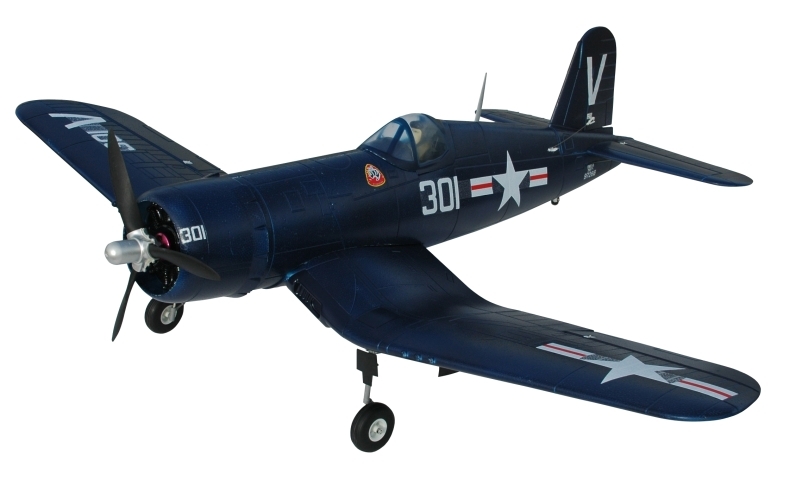
Send a questionThe Vought F-4U Corsair was the most powerful American carrier-based fighter aircraft of World War II. After its initial problems were resolved (an overly stiff landing gear and poor cockpit visibility, which made carrier landings difficult), it helped, alongside the Grumman Hellcat, sweep Japanese aircraft from the skies over the Pacific. Corsairs also operated successfully in the colours of the British Fleet Air Arm and from land bases with Marine Corps squadrons. They remained in service with the US Navy and Marines well into the 1950s, when, as fighter-bombers, they played a significant role in halting the initial assault by communist North Korea at the start of the Korean War.
Our new Corsair, made from almost indestructible extruded expanded polypropylene (EPP), pushes the boundaries of what this technology can do. While EPP semi-scale models with a wingspan of around 1 metre or less were the norm until now, our Corsair boasts a wingspan of 1430 mm! This is a size for which, until quite recently, a 6.5 cc glow engine was practically the only acceptable power source—this is a proper full-size fighter! Its large size, attractive warbird appearance and good flight characteristics make the EPP Corsair an excellent model, with a mild dose of combat adrenaline, for a pilot who can confidently fly a faster aileron-equipped model...
The model's EPP foam fuselage is supplied with a C4250-500 outrunner brushless motor installed (with output between that of the AXI 2826 and 4120), a 50 A brushless ESC with a powerful switching SBEC and servos for the rudder, elevator and tailwheel. The removable canopy with magnetic catch provides easy access to the onboard electronics and flight battery. You will need a LiPo 4-cell battery of at least 2600 mAh with a 20C discharge rating, though the model can also carry larger 2500–4000 mAh 4-cell batteries, which will suitably extend the flight time. The EPP tail surfaces are attached to the fuselage with polyamide screws. The two-piece EPP wing has a semi-symmetrical airfoil and is attached to the fuselage with four screws and clips. The ailerons are controlled by two servos housed in the wing. You can also add controls for the outer flap sections (the full-size Corsair had flaps divided into three sections on each wing half). Before connecting the pushrods, we recommend gently moving the control surfaces repeatedly up and down or left and right to free them up. The wing is fitted with electric retractable landing gear and an electronic sequencer, which synchronises the extension and retraction of the landing gear legs and the opening and closing of the gear doors (it is controlled by a standard receiver signal, like a servo). The tailwheel is steerable and controlled by a separate servo, which connects to the rudder channel via a Y-cable. The ailerons, rudder, elevator, motor speed and retractable landing gear are controlled.
You will need at least a six-channel RC system to control the model (unless you plan to use flaps). If you also intend to install flap controls, you will need an RC system with at least seven channels. Follow the instructions for your RC system when connecting the receiver.
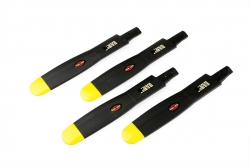
The model comes with a scale spinner and a 14x89" four-blade propeller.
The ARF kit contains:
PLEASE NOTE: Due to an oversight when preparing the instructions, the centre of gravity is incorrectly indicated in some printed copies. It should be 90 mm behind the wing's leading edge at the fuselage. We sincerely apologise for this error.
Notice
Under Commission Delegated Regulation (EU) 2019/945 of 12 March 2019 on unmanned aircraft systems and on third-country operators of unmanned aircraft systems, and Commission Implementing Regulation (EU) 2019/947 of 24 May 2019 on the rules and procedures for the operation of unmanned aircraft, operators and pilots of unmanned aircraft (traditional model aircraft, multicopters, drones) weighing more than 250 g or carrying a camera or other sensor capable of capturing personal data in any way are required to register (in the Czech Republic, with the Civil Aviation Authority). More information is available here: Registration of drone operators and pilots.
| Wingspan [mm] | 1430 |
| Length [mm] | 1140 |
| Weight [g] | 2000 |
| Wing area [dm2] | 33.9 |
| Controlled functions | S,V,K(2),M,P |
| Building difficulty | S1 |
| Piloting difficulty | P2,P3 |
Power system and RC equipment:
| ARF kit | |
| Motor | *C4250-500 |
| Speed controller | *brushless 50A |
| Propeller | *14x8E" four-blade |
| Battery | RAY G3 14,8 V 2700 mAh |
| Servos | *micro 6x 9g, 1x 17g |
| RC system | min. 6 channels |
| *) Included in the ARF kit | |
7 items



This website is using cookies
In order to improve our services, we use cookies on this website. For more information go to Terms and conditions for use of website.