








Customer line 9 am - 6 pm: +420 774 590 258 | Do you need help?


| Price in e-shop with VAT: | 573,36 € |
|
Stock
Tuesday 24.11. you can have it at the Nademlejnská central store Wednesday 25.11. it can be at your place |
|
|
|
Buy |
| Buy | |
|
35 years in business = safe shopping and professional service |
|
Don't know how to choose? Are some parameters not clear to you? Write us your question and we will contact you with an answer.
Send a questionThe Viper sport jet was originally developed in the 1990s as an amateur-built aircraft powered by a pusher piston engine with a multi-blade propeller. However, because its designers still needed more thrust, after several redesigns and tests with various jet engines, they arrived in 2005 at a version powered by a General Electric J85 engine, which finally satisfied the Hanchette brothers. And no wonder—the J85 powers aircraft such as the lightweight Northrop F-5 fighter and the Cessna A-37 Dragonfly attack aircraft! If you don't have around $650,000 to buy a full-size kit and 3,500 hours to build it, you can try our ARF set, which will be ready to fly in the time it takes to charge the flight battery! The small Viper won't break the sound barrier, but it can easily reach around 150–170 km/h.
A semi-scale model of an American sport jet made of EPP foam, powered by a 90 mm ducted fan with a brushless motor. The model is intended for more experienced pilots who can already confidently fly conventional aerobatic models.
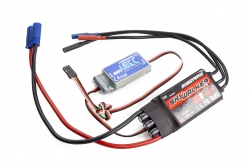
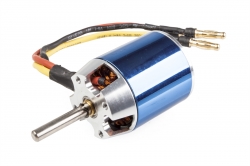
The model's fuselage is made of EPP foam molded in a negative mold. The 90 mm ducted fan is located in the rear of the fuselage; it can be accessed by removing the cover on the underside, which is secured with 2 screws. The fan is powered by a BL3541-1450 brushless motor with a Hobbywing 80 Opto ESC. A Hobbywing UBEC voltage regulator rated at 8 A is installed to power the onboard electronics. The electronics and 6S LiPo flight battery are housed in the cockpit beneath a large removable canopy. At the rear of the cockpit is an electronics connection board, to which the cables for the tail surface servos and nose gear steering, as well as the wiring harnesses from the servos in the wing halves, are connected. Individual servo leads extend from the board for connection to your receiver. At the front of the cockpit is an electronic sequencer that controls the retractable landing gear.
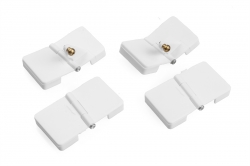
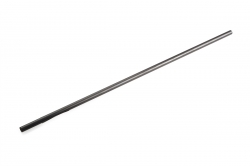
The two-piece wing, with a semi-symmetrical airfoil and elegant winglets, is also made of EPP foam and joined using a carbon-fiber tube spar. The ailerons and slotted flaps are controlled by short, straight pushrods with ball links and two pairs of servos mounted on easily removable plastic covers. LED navigation lights are installed beneath the plastic covers on the wing's leading edge. For simplicity, the cables for all servos and the retractable landing gear are routed into a wiring harness terminated with a single multi-connector, which plugs into the connection board in the fuselage once the wing is attached.
The tail surfaces are made of EPP foam and secured to the fuselage with screws. The control surfaces are operated by servos located in the fin and horizontal stabilizer, respectively, and mounted on easily removable plastic covers.
The landing gear is a tricycle-type electric retractable system with sprung duralumin struts. The landing gear doors are operated by separate servos, and the gear is controlled by an electronic sequencer that ensures truly scale-like operation: for example, on the main wing gear, the wheel door opens first, then the gear extends or retracts, and finally the wheel door closes again. The nose gear is controlled by a separate servo connected to the rudder channel.
All servos are 9 g digital servos with metal gears.
You will need at least a six-channel RC system to control the model if you keep the default setup, in which both aileron servos, both flap servos and both elevator servos are connected (via the electronics connection board) to a single receiver channel. If you want to retain independent control of the servos for these functions, you will need at least a nine-channel RC system—and you won't use the connection board in the fuselage for these functions.
You will need a 6-cell 22.2 V 5000 mAh LiPo battery with a rating of at least 30 C as the flight battery. The ESC in the model is fitted with an EC5 connector (PELIKAN DANIEL #7956/7957).
Package contents
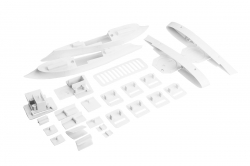
The ARF set contains: EPP foam fuselage with installed ducted fan, brushless motor, ESC, UBEC voltage regulator, electrically retractable nose gear and 2 servos; EPP wing with installed aileron and flap servos, electrically retractable landing gear and 2 landing gear door servos; EPP tail surfaces with installed servos; wing joiner, screw set and instructions.
Notice
Under Commission Delegated Regulation (EU) 2019/945 of 12 March 2019 on unmanned aircraft systems and on third-country operators of unmanned aircraft systems, and Commission Implementing Regulation (EU) 2019/947 of 24 May 2019 on the rules and procedures for the operation of unmanned aircraft, operators and pilots of unmanned aircraft (conventional model aircraft, multicopters, drones) weighing more than 250 g or carrying a camera or other sensor capable of capturing personal data in any way are required to register (in the Czech Republic, with the Civil Aviation Authority). Further information is available here: Registration of drone operators and pilots.
| Wingspan [mm] | 1450 |
| Length [mm] | 1274 |
| Weight [g] | 3050 |
| Wing area [dm2] | 32 |
| Controlled functions | S,V(2),K(2),M,P(3),F(2),Nose gear |
| Building difficulty | S1 |
| Flying difficulty | P2,P3 |
Power system and RC equipment:
| Motor | *BL3541-1450 |
| Speed controller | *brushless Hobbywing 80A Opto |
| EDF unit | *90 mm, 11 blades |
| Battery | FOXY G2 22,2 V 5000 mAh |
| Servos | *11x micro S009 digital |
| RC system | min. 6 channels |
| *) Included in the ARF set | |
6 items
This website is using cookies
In order to improve our services, we use cookies on this website. For more information go to Terms and conditions for use of website.