








Customer line 9 am - 6 pm: +420 774 590 258 | Do you need help?
| Price in e-shop with VAT: | 184,02 € |
|
Stock
Tuesday 24.11. you can have it at the Nademlejnská central store Wednesday 25.11. it can be at your place |
|
|
|
Buy |
| Buy | |
|
35 years in business = safe shopping and professional service |
|
Don't know how to choose? Are some parameters not clear to you? Write us your question and we will contact you with an answer.
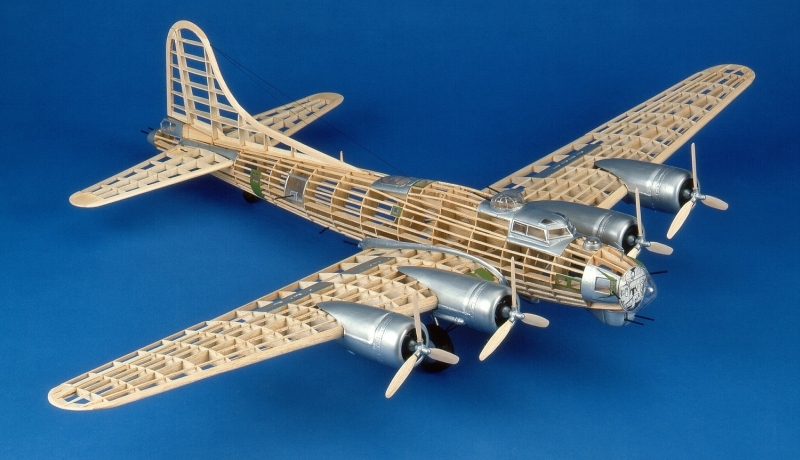
Send a questionThe four-engine high-speed Boeing B-17 Flying Fortress bomber held great promise at the start of the war. The US Army Air Forces command expected it to be able to operate by day over enemy territory without fighter escorts and accurately release its deadly bomb load from high altitude using the Norden bombsight, an electromechanical onboard computer. Its first combat missions, initially with the RAF, then against the Japanese in the Philippines, and the daylight raids on the Third Reich in 1943 showed that reality was different. To achieve a victorious bombing offensive from airfields in Britain and southern Italy, the aircraft had to be completely redesigned and fitted with numerous turrets and gun positions; the large vertical tail with its extended fin solved stability problems—and, most importantly, formations of “Flying Fortresses” received protection from Mustang fighters along the entire route. Only then did the B-17Gs, together with Liberators, wipe out German oil refineries and synthetic gasoline factories, and disrupt transport by destroying railway stations and rail yards...
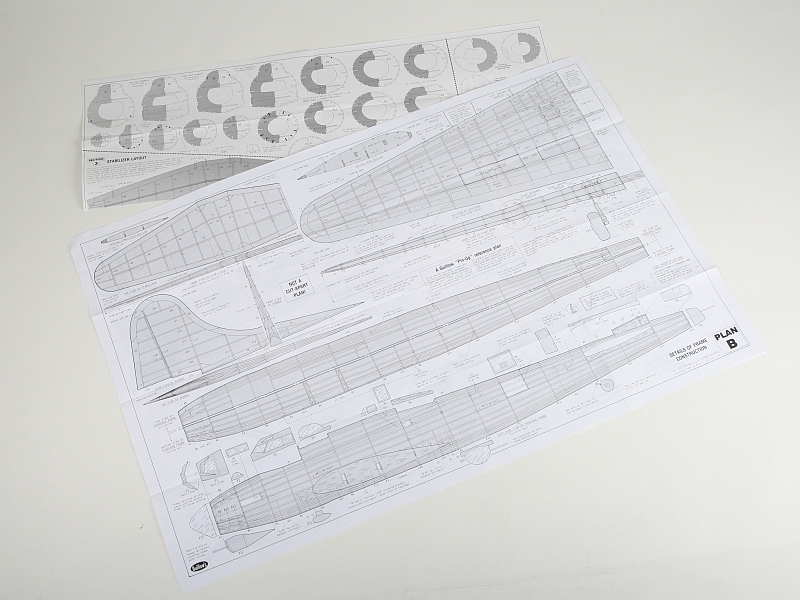
Kit for a control-line scale model of a four-engine low-wing bomber designed to be powered by two 1.5 cc engines; the instructions and plan also allow you to build the model as a static display model with finely detailed scale features, including a museum-quality cockpit interior, in 1:28 scale (this version is shown in a special “Action Plan” drawing).
The model features traditional all-balsa construction with die-cut wooden parts, scale accessories made from vacuum-formed plastic, injection-moulded plastic parts, and die-cut parts made from “plastic plywood”, a light and strong material that replaces conventional plywood. The fuselage is, of course, built using true rubber-powered scale model construction techniques, with formers and numerous stringers that allow the rounded shapes to be faithfully reproduced. It is built in two stages: thanks to the “split” along the vertical plane, you first build one half of the fuselage directly on the workbench, then “glue on” the other half. This ensures that even a fuselage with complex shapes can be built straight and symmetrical, without the need for any special jigs. The wing is built in the traditional way from ribs and spars. As this is a model for an advanced builder, you should already have previous experience with traditional construction.
The Flying Fortress is also suitable for conversion to an RC model with electric power or two 0.8–1.5 cc glow engines—although the building plan does not offer these options, they should not be a major challenge for an experienced modeller.
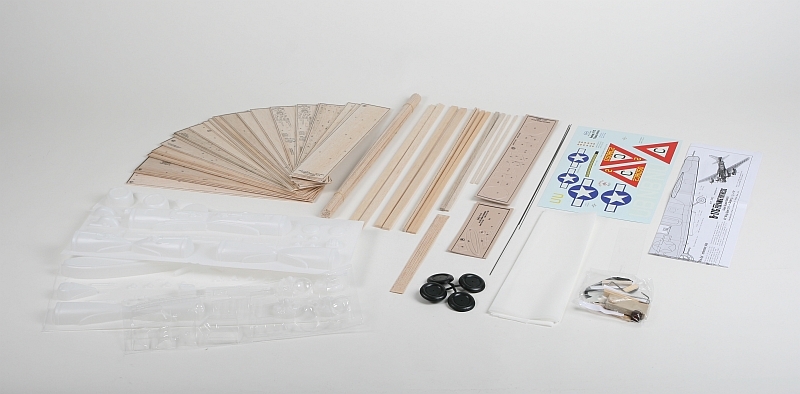
The kit contains
die-cut balsa parts, balsa spars, die-cut plastic plywood parts, vacuum-formed scale parts (engine cowlings, engines, fuselage nose...), plastic wheels, steel wire for the landing gear and other small parts, covering tissue, a sheet of water-slide decals, building plan.
Building tip: DO NOT punch out the die-cut parts! Turn the sheet over, place it on the workbench and lightly sand it with fine sandpaper (No. 220 or finer). The parts can then be separated more easily; if they are still “attached” to the sheet by some wood fibres, carefully cut them free with a sharp modelling knife.
| Wingspan [mm] | 1149 |
| Length [mm] | 868 |
| Controlled functions | None |
| Build difficulty | S4 |
| Piloting difficulty | P0 |
2 items
This website is using cookies
In order to improve our services, we use cookies on this website. For more information go to Terms and conditions for use of website.