






Customer line 9 am - 6 pm: +420 774 590 258 | Do you need help?
| Price in e-shop with VAT: | 26,19 € |
| Temporarily unavailable | |
|
|
Send a question
on availability |
|
Send a question
on availability |
|
|
35 years in business = safe shopping and professional service |
|
Don't know how to choose? Are some parameters not clear to you? Write us your question and we will contact you with an answer.
#Chcete dostat upozornění ve chvíli, kdy produkt bude k dispozici? Stačí vyplnit formulář a náš hlídací pes Vám dá vědět.
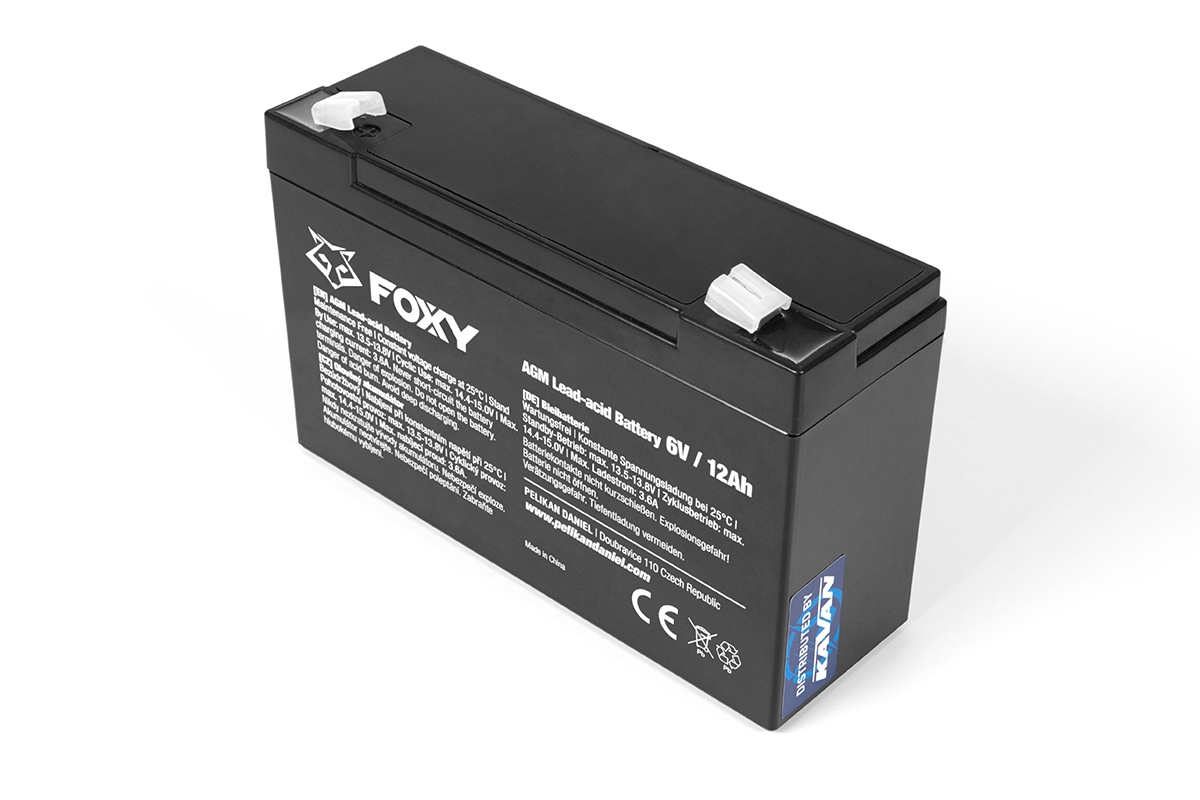
6 V maintenance-free lead-acid AGM battery with resettable valves and terminals for 4.8 mm FASTON connectors.
Foxy maintenance-free lead-acid batteries use modern AGM (Absorbent Glass Mat) technology, with the electrodes separated by a separator made of non-woven glass fibre fabric saturated with electrolyte. The battery is completely sealed in an ABS plastic casing, so under normal conditions there is no risk of electrolyte leakage. A safety valve protects against explosion in the event of overcharging or over-discharging.
Battery installation
Protect the battery from vibrations, knocks and impacts that may occur during operation of RC models or when installed in portable devices (starter boxes, etc.) by wrapping it in foam rubber or a similar material. Secure it in an easily accessible location where it is protected from fuel, exhaust gases and other operating fluids or water getting in.
The batteries are fitted with standard terminals for 4.8 mm (0.187“) FASTON connectors. The terminal sealed in red epoxy resin is positive (+); the terminal sealed in black resin is negative (-). Lead-acid batteries are HEAVY, so make sure your battery holder is sufficiently strong.
General guidelines for handling and discharging lead-acid batteries
The maximum peak discharge current must not exceed ten times the numerical value of the battery's rated capacity (10C); the continuous discharge current should not exceed 3C. For example, the maximum discharge current of a 3 Ah battery is 10×3=30 A, and the continuous current is 9 A.
Deep discharge causes permanent damage to the battery and significantly shortens its service life. You can prevent this by never fully discharging the battery (not below 1.8 V per cell), always switching off connected electrical equipment after use, and recharging the battery in good time.
Charging for cyclic and standby operation
Charging should be performed in constant current–constant voltage mode (“CC/CV"). This means the charger must operate so that the maximum permissible charging current and maximum charging voltage are not exceeded. The maximum charging voltage depends on the battery's mode of operation and temperature. It may be higher (2.40–2.50 V per cell) for cyclic full-charge/full-discharge operation, which is typical when using the battery to power models, electric starters, power panels, etc.
In standby mode, where the battery is kept fully charged at all times (UPS backup power supplies, emergency lighting power supplies, etc.), the maximum permitted voltage is lower (2.26–2.30 V). The higher the ambient temperature, the lower the permitted final charging voltage.
If you do not have an automatic charger for lead-acid batteries that accurately monitors the charging process and automatically keeps the current and final voltage within the permitted limits, use only “slow charging” at a current of 0.1C, i.e. a current numerically equal to one tenth of the battery's rated capacity. Example: 10 Ah battery – slow charging at 0.1C = 10 (Ah) / 10 = 1 A. At this current, it takes approximately 14 hours to charge a fully discharged battery. Charging should be stopped immediately after this time.
Battery service life
As soon as a battery is manufactured, it begins to undergo natural ageing, which causes its performance to deteriorate, whether or not it is in use. Its service life depends greatly on the mode of operation (cyclic/standby), level of load, depth of discharge, operating temperature and humidity, etc. For example, tests of Foxy batteries under laboratory conditions at temperatures of 20–25 °C show a typical service life of over 1,000 cycles when discharged to 70%, over 400 cycles when discharged to 50%, and over 200 cycles when discharged to 100%.
Storage
Store batteries fully charged in a dry environment at a temperature of +5 °C to +30 °C and a maximum humidity of 50%. When stored at 25 °C, self-discharge is approximately 3% per month. If batteries are stored for longer than 1 year, they must first be fully recharged.
| Capacity [mAh] | 12 000 |
| Voltage (nominal) [V] | 6 |
| Voltage (final, for cyclic operation) [V] | 7,2–7,5 |
| Voltage (final, for standby use) [V] | 6,8–6,9 |
| Charging current (max.) [A] | 3,6 |
| Discharge current (continuous) [A] | 36 |
| Discharge current (peak) [A] | 120 |
| Internal resistance (fully charged, at 25 °C) [mOhm] | 10 |
| Length [mm] | 151 |
| Width [mm] | 50 |
| Height [mm] | 94 |
| Height (overall, including terminals) [mm] | 100 |
| Weight [g] | 2050 |
This website is using cookies
In order to improve our services, we use cookies on this website. For more information go to Terms and conditions for use of website.