






Customer line 9 am - 6 pm: +420 774 590 258 | Do you need help?
| Price in e-shop with VAT: | 13,48 € |
| Temporarily unavailable | |
|
|
Send a question
on availability |
|
Send a question
on availability |
|
|
35 years in business = safe shopping and professional service |
|
Don't know how to choose? Are some parameters not clear to you? Write us your question and we will contact you with an answer.
#Chcete dostat upozornění ve chvíli, kdy produkt bude k dispozici? Stačí vyplnit formulář a náš hlídací pes Vám dá vědět.
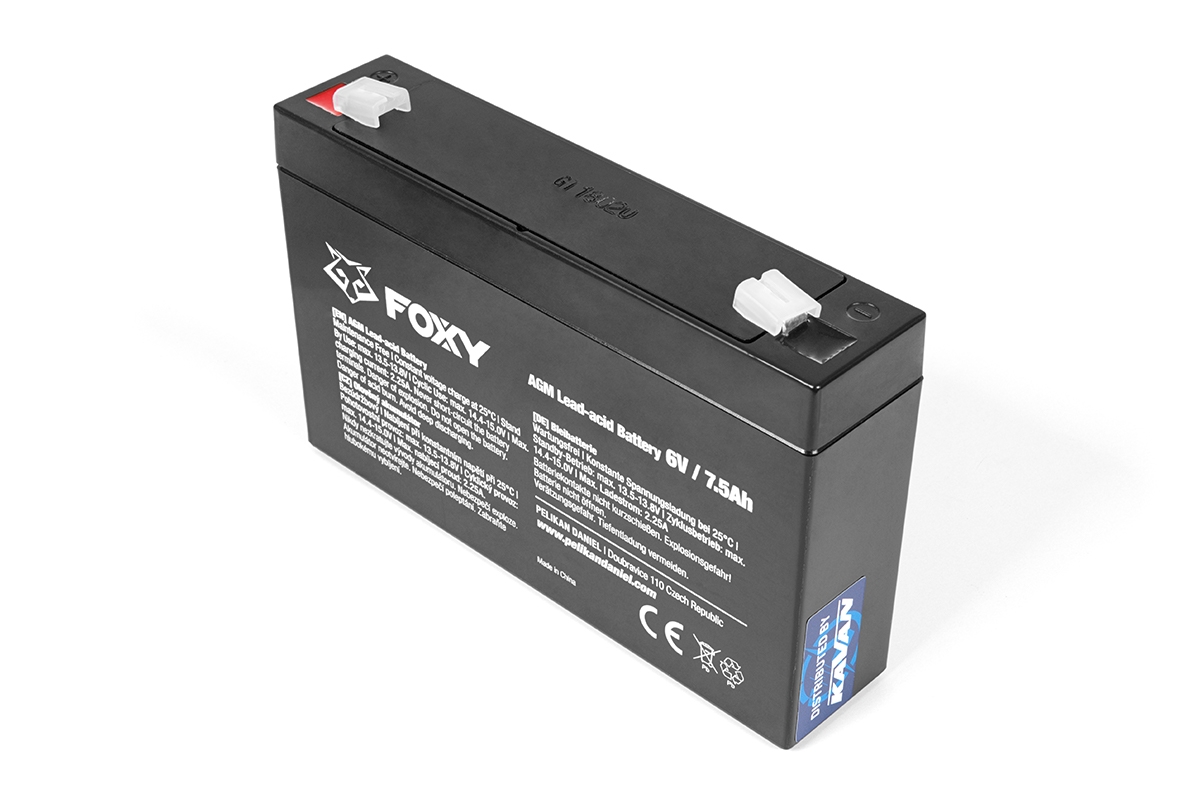
6 V maintenance-free lead-acid AGM battery with reversible valves and terminals for FASTON 4.8 mm connectors.
Foxy maintenance-free lead-acid batteries use modern AGM (Absorbent Glass Mat) technology, with the electrodes separated by a non-woven glass-fibre separator saturated with electrolyte. The battery is completely sealed in an ABS plastic case, so under normal conditions there is no risk of electrolyte leakage. A safety valve protects against explosion in the event of overcharging or excessive discharge.
Battery installation
Protect the battery from vibrations, impacts and shocks that may occur during operation of RC models or when installed in portable equipment (starter boxes, etc.) by wrapping it in foam rubber or similar material. Secure it in an easily accessible location, while protecting it from fuel, exhaust gases and other operating fluids or water.
The batteries are fitted with standard terminals for FASTON 4.8 mm (0.187“) connectors. The terminal sealed in red epoxy resin is positive (+), while the terminal sealed in black resin is negative (-). Lead-acid batteries are HEAVY, so make sure your battery holder is sufficiently sturdy.
General guidelines for handling and discharging lead-acid batteries
The maximum peak discharge current must not exceed ten times the numerical value of the battery's rated capacity (10C); the continuous discharge current should not exceed 3C. For example, the maximum discharge current for a 3 Ah battery is 10×3=30 A, and the continuous current is 9 A.
Deep discharge causes permanent damage to the battery and significantly shortens its service life. You can prevent this by never completely discharging the battery (not below 1.8 V per cell), always switching off connected electrical equipment after use, and recharging the battery in good time.
Charging for cyclic and standby operation
Charging should use the constant current – constant voltage (“CC/CV") mode. This means the charger must operate so that neither the maximum permissible charging current nor the maximum charging voltage is exceeded. The maximum charging voltage depends on how the battery is used and on the temperature. It may be higher (2.40–2.50 V per cell) for cyclic operation involving full charge/full discharge, which is typical when using the battery to power models, electric starters and power panels, etc.
In standby mode, when the battery is kept fully charged at all times (UPS backup power supplies, emergency lighting power supplies, etc.), the maximum permitted voltage is lower (2.26–2.30 V). The higher the ambient temperature, the lower the permitted final charging voltage.
If you do not have an automatic charger for lead-acid batteries that accurately monitors the charging process and automatically keeps the current and final voltage within the permitted limits, use only “slow charging” at a current of 0.1C, i.e. a current numerically equal to one tenth of the battery's rated capacity. Example: 10 Ah battery – slow charging at 0.1C = 10 (Ah) / 10 = 1 A. At this current, a fully discharged battery takes approximately 14 hours to charge. Charging should be stopped immediately after this time.
Battery service life
Once manufactured, a battery begins to age naturally, which causes its performance to deteriorate, regardless of whether it is used or not. Its service life depends greatly on the operating mode (cyclic/standby), load level, depth of discharge, operating temperature and humidity, etc. For example, tests of Foxy batteries under laboratory conditions at temperatures of 20–25 °C show a typical service life of over 1,000 cycles when discharged to 70%, over 400 cycles when discharged to 50%, and over 200 cycles when discharged to 100%.
Storage
Store batteries fully charged in a dry environment at a temperature of +5 °C to +30 °C and a maximum humidity of 50%. When stored at 25 °C, self-discharge is approximately 3% per month. If batteries are stored for longer than 1 year, they must be fully recharged before use.
| Capacity [mAh] | 7500 |
| Voltage (nominal) [V] | 6 |
| Voltage (final, for cyclic operation) [V] | 7,2–7,5 |
| Voltage (final, for standby use) [V] | 6,8–6,9 |
| Charging current (max.) [A] | 2,2 |
| Discharge current (continuous) [A] | 22,5 |
| Discharge current (peak) [A] | 75 |
| Internal resistance (fully charged, at 25 °C) [mOhm] | 12 |
| Length [mm] | 151 |
| Width [mm] | 34 |
| Height [mm] | 94 |
| Height (overall, including terminals) [mm] | 100 |
| Weight [g] | 1230 |
This website is using cookies
In order to improve our services, we use cookies on this website. For more information go to Terms and conditions for use of website.